What Happens If You Leave a Missing Tooth Untreated?
Losing a tooth can affect more than the appearance of your smile. Even when the gap is not visible, a missing tooth may influence how you chew, how neighbouring teeth are positioned and how your bite functions. Over time, the surrounding jawbone may also change because it no longer receives stimulation from the missing tooth root.
Some people delay treatment because they do not experience pain or believe that a single missing tooth will not cause significant problems. However, the consequences of missing teeth can develop gradually, making it important to understand the potential effects and available treatment options.
If you have lost a tooth due to decay, gum disease, injury or extraction, appropriate missing tooth treatment can help restore function and prevent certain complications.
At TDC Dental, patients can discuss suitable replacement options based on their oral health, the location of the missing tooth and their individual treatment needs.
What Happens When You Leave a Missing Tooth Untreated?
The effects of an untreated missing tooth vary depending on its location, the condition of surrounding teeth and how your bite functions. Not everyone will experience every complication, but several changes may occur over time.
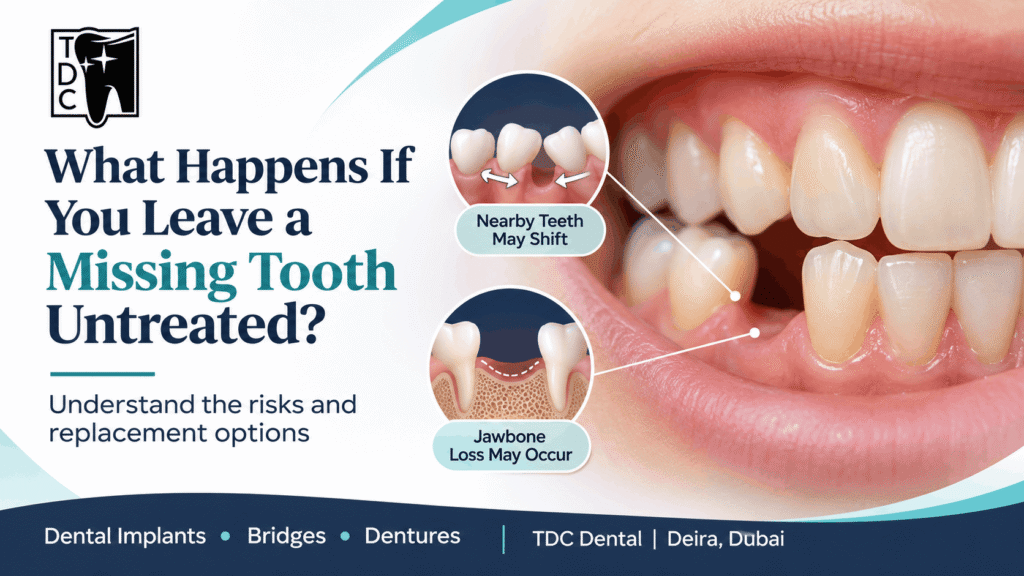
1. Nearby Teeth May Shift
Your teeth help maintain one another’s position within the dental arch. When a tooth is missing, the neighbouring teeth may gradually move or tilt towards the empty space.
This movement can affect the alignment of your teeth and create changes in your bite. It may also make certain areas more difficult to clean, increasing the risk of plaque accumulation and gum problems.
The opposing tooth may also move into the space if there is no tooth above or below it to maintain contact. This is known as over-eruption.
Also Read More – Who Is a Good Candidate for Dental Implants?
2. Jawbone Loss May Occur
One of the important consequences of missing teeth is the gradual loss of bone in the area where the tooth was located.
Natural tooth roots stimulate the surrounding jawbone during chewing. When a tooth is lost, this stimulation decreases, and the bone may gradually shrink.
The amount of bone change varies between individuals and depends on factors such as the reason for tooth loss, the location of the missing tooth and the time since extraction.
Bone loss can sometimes make future dental implant treatment more complex because sufficient bone is needed to support an implant. In selected cases, bone grafting may be considered.
3. Chewing and Eating May Become Difficult
Missing teeth can affect your ability to bite and chew food comfortably. This is particularly noticeable when molars or several teeth are missing because these teeth play an important role in grinding food.
You may begin chewing more on one side of your mouth to avoid the gap or areas of discomfort. This can change your normal chewing pattern and place additional pressure on the remaining teeth.
If eating becomes difficult, it may also affect the range of foods you feel comfortable consuming.
4. Your Bite May Change
Your upper and lower teeth work together to distribute chewing forces. A missing tooth can change how these teeth meet, particularly if neighbouring or opposing teeth begin to move.
Changes in your bite may contribute to uneven pressure on certain teeth. Some people may notice discomfort when chewing or changes in how their teeth come together.
A dental examination can help identify whether the missing tooth has affected your bite and whether treatment is recommended.
5. Food May Become Trapped More Easily
Gaps between teeth can allow food to collect around the missing tooth space or between neighbouring teeth. If these areas are difficult to clean, plaque can accumulate and contribute to gum inflammation or tooth decay in the remaining teeth.
Maintaining good oral hygiene is important, but brushing alone may not address all the changes caused by an untreated gap.
6. Your Smile and Confidence May Be Affected
A missing front tooth can be noticeable when speaking or smiling. Even a missing back tooth, which is less visible, may affect confidence or make you feel uncomfortable about your appearance.
Replacing a missing tooth can help restore the appearance of your smile while also addressing functional concerns.
Can One Missing Tooth Cause Problems?
Yes. Even a single missing tooth can affect the surrounding dental structures, depending on its location and the condition of your remaining teeth.
For example:
- A missing front tooth may affect speech, appearance and biting.
- A missing premolar may influence chewing and the balance of your bite.
- A missing molar may reduce chewing efficiency and allow nearby teeth to shift.
- A missing tooth in an already compromised dental arch may contribute to further bite changes.
The impact is not always immediate. Some people experience no noticeable symptoms for a while, but this does not mean that the gap has no effect on their oral health.
If you want to replace one missing tooth, a dentist can assess the space, surrounding teeth, gum condition and jawbone before recommending treatment.
When Should You Consider Missing Tooth Treatment?
It is worth arranging a dental assessment after losing a tooth, even if the area feels comfortable.
You may need missing tooth treatment if:
- You have difficulty chewing on one side.
- Nearby teeth appear to be shifting.
- Food frequently becomes trapped around the gap.
- You notice changes in your bite.
- The missing tooth affects your smile or confidence.
- You want to reduce the risk of further dental complications.
The right time to replace a tooth depends on your clinical condition. In some situations, treatment may be planned soon after extraction. In others, the dentist may recommend allowing the area to heal first.
Missing Tooth Replacement Options in Deira
There are several ways to replace a missing tooth. The most appropriate option depends on how many teeth are missing, the condition of your gums and jawbone, your bite and your treatment preferences.
1. Dental Implants
A dental implant is a small post placed into the jawbone to act as an artificial tooth root. After the implant integrates with the bone, a crown can be attached to replace the visible part of the missing tooth.
Implants can be used to replace a single tooth without relying on neighbouring teeth for support. They may also support bridges or dentures when several teeth are missing.
Potential benefits include:
- A fixed replacement for the missing tooth.
- Support for normal chewing function.
- No need to prepare adjacent healthy teeth for a conventional bridge.
- Help in maintaining bone in the area through functional stimulation.
However, implants require surgery and sufficient bone support. Some patients may need additional procedures, such as bone grafting. They also require regular cleaning and professional maintenance.
2. Dental Bridges
A dental bridge replaces a missing tooth by using the neighbouring teeth or other supporting structures to hold an artificial tooth in place.
A conventional dental bridge is generally supported by crowns placed on adjacent teeth. This may be suitable when the neighbouring teeth already need crowns or when an implant is not appropriate.
Potential benefits include:
- A fixed replacement option.
- No implant surgery for a conventional tooth-supported bridge.
- A treatment timeline that may be shorter than implant treatment in some cases.
A conventional bridge usually requires preparation of the supporting teeth. These teeth need to be healthy enough to provide reliable support, and the area beneath the replacement tooth requires careful cleaning.
3. Removable Partial Dentures
A removable partial denture can replace one or more missing teeth. It is designed to fit around the remaining natural teeth and can be removed for cleaning.
This may be an option when several teeth are missing or when a fixed replacement is not suitable. The design and stability depend on the number and position of missing teeth and the condition of the remaining teeth.
Your dentist can explain whether a removable denture is appropriate for your needs.
Dental Bridge vs Implant: Which Is Better for One Missing Tooth?
Both dental bridges and implants can replace a missing tooth, but they work differently. The right option depends on your oral health, bone condition, adjacent teeth and treatment preferences.
| Feature | Dental Implant | Conventional Dental Bridge |
| Support | Placed in the jawbone | Supported by adjacent teeth |
| Effect on neighbouring teeth | Usually does not require preparation of adjacent healthy teeth | Usually requires preparation of supporting teeth |
| Surgery | Requires a surgical procedure | Usually does not require implant surgery |
| Bone support | Requires adequate bone or suitable augmentation | Does not require an implant in the jawbone |
| Treatment time | Includes a healing and integration period | May be completed in fewer stages |
| Maintenance | Requires careful cleaning and professional reviews | Requires careful cleaning around and beneath the bridge |
An implant may be considered when the jawbone and general health support surgery. A bridge may be more appropriate when the adjacent teeth need restoration or implant treatment is unsuitable.
Neither option is automatically better for every patient. A clinical examination is needed to make a suitable recommendation.
What Is the Cost of Replacing a Missing Tooth in Deira?
The cost of replacing a missing tooth in Deira depends on the treatment selected and the complexity of your case. A dental implant, conventional bridge and removable denture involve different procedures, materials and appointments.
Factors that may influence the total cost include:
- The type of replacement selected.
- The number of missing teeth.
- The condition of the surrounding teeth and gums.
- The amount of available jawbone.
- Whether tooth extraction or bone grafting is required.
- Diagnostic imaging and other clinical procedures.
- The type of crown, bridge or denture used.
For example, implant treatment may involve implant placement, an abutment and a final crown, while a conventional bridge may involve preparing and restoring adjacent teeth.
The best way to understand the expected cost is to arrange a consultation and request a treatment plan with a clear breakdown of the recommended procedures and fees.
Can a Missing Tooth Be Replaced Years Later?
In many cases, yes. A missing tooth can sometimes be replaced years after the original tooth was lost. However, the longer the gap remains, the more likely it is that changes may have occurred in the surrounding teeth and jawbone.
Your dentist may need to assess:
- Whether neighbouring teeth have shifted.
- Whether the opposing tooth has moved into the gap.
- Whether there is enough jawbone for an implant.
- Whether gum disease or tooth decay needs treatment.
- Whether your bite has changed.
If bone loss has occurred, additional treatment may be necessary before an implant can be placed. A bridge or removable denture may also be considered depending on the condition of your remaining teeth.
Delaying treatment does not automatically prevent future replacement, but it can affect the available options and complexity of care.
Read More – How Long Does a Dental Implant Take to Heal?
Treatment for Gaps Between Teeth: Why a Dental Assessment Matters
Not every gap between teeth is caused by a missing tooth. Some spaces develop naturally, while others may result from gum disease, tooth movement, previous extraction or changes in the dental arch.
The treatment for gaps between teeth depends on the underlying cause.
If a tooth is missing, replacement options may include an implant, bridge or removable denture. If the gap is caused by tooth spacing rather than tooth loss, orthodontic treatment or other restorative options may be considered.
It is important to identify the reason for the gap before choosing treatment. Simply closing a space without addressing the underlying problem may not provide a suitable long-term result.
Discuss Missing Tooth Treatment at TDC Dental
Leaving a missing tooth untreated may lead to changes in the surrounding teeth, jawbone and bite. Even if you are not experiencing pain, understanding the condition of the gap can help you make an informed decision about your oral health.
Whether you want to replace one missing tooth or are considering treatment for multiple gaps, TDC Dental can assess your dental condition and discuss suitable replacement options.
Arrange a consultation at TDC Dental in Deira to understand your treatment choices, expected timeline and associated costs.
Frequently Asked Questions
What happens if you do not replace a missing tooth?
Nearby teeth may shift, the opposing tooth may move into the gap and jawbone loss may occur over time. You may also experience changes in chewing, bite alignment and food trapping. The effects vary depending on the location of the missing tooth.
Is it necessary to replace one missing tooth?
Not every missing tooth requires the same treatment, but an assessment is recommended. A dentist can evaluate the potential effects on your bite, neighbouring teeth and jawbone before advising whether replacement is appropriate.
What is the best treatment for one missing tooth?
Dental implants and conventional bridges are common fixed options. Removable partial dentures may also be suitable in certain situations. The best choice depends on your oral health, bone condition, adjacent teeth and preferences.
Is a dental implant better than a bridge?
An implant replaces the missing tooth root and usually does not require preparation of adjacent healthy teeth. A bridge uses neighbouring teeth for support and may be suitable when those teeth already need crowns. Your dentist can compare the options based on your clinical condition.
Can I get a dental implant years after losing a tooth?
Yes, many patients can receive implants years after tooth loss. However, bone loss or movement of nearby teeth may affect treatment planning. An examination and appropriate imaging can help determine whether additional treatment is needed.
Does leaving a missing tooth cause bone loss?
It can. When a tooth is lost, the jawbone in that area no longer receives stimulation from its root. The bone may gradually shrink, although the extent and rate of change vary between individuals.
How much does it cost to replace a missing tooth in Deira?
The cost depends on whether you choose an implant, bridge or removable denture, as well as the number of procedures required. A personalised treatment plan is needed to provide an accurate estimate.