Dental Implants vs Dentures: Which Option Is Right for You?
Missing teeth can affect how you eat, speak and feel about your smile. Whether you have lost a single tooth or several teeth, choosing an appropriate replacement can help restore oral function and improve your quality of life. Two commonly considered solutions are dental implants and dentures. However, understanding the differences between them is essential before deciding which treatment may suit your needs.
When comparing dental implants vs dentures, it is important to look beyond the initial price. Factors such as jawbone health, comfort, stability, maintenance, treatment time and long-term costs can influence your decision.
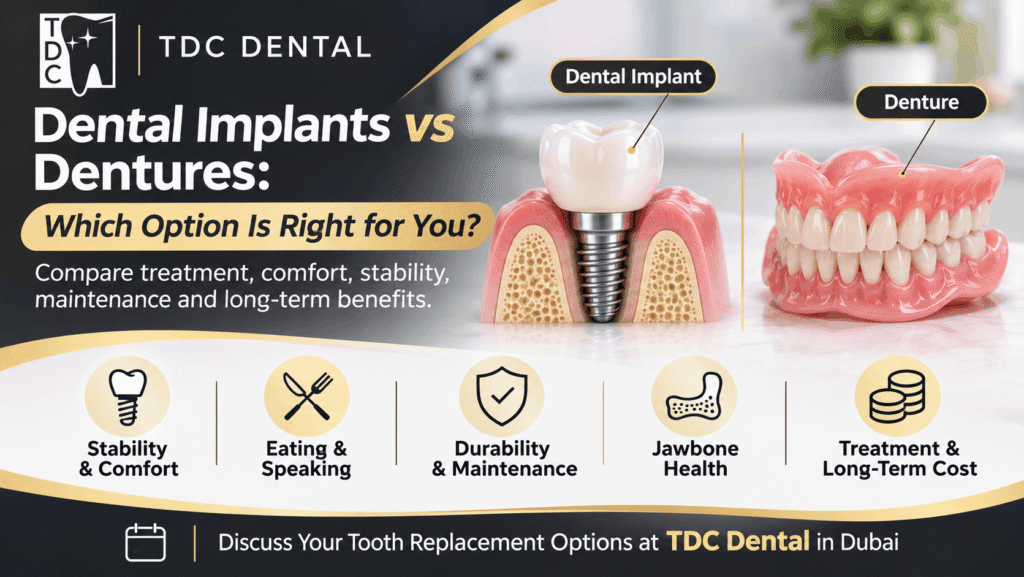
Dental implants are placed in the jawbone to support replacement teeth, while conventional dentures are removable appliances designed to replace missing teeth and surrounding structures. Implant-supported dentures combine aspects of both approaches by using dental implants to improve the stability of a denture.
At TDC Dental, patients can enquire about available tooth replacement options and discuss their individual needs with the dental team. This guide explains how dental implants and dentures differ, what affects their costs and which factors to consider when selecting a tooth replacement solution in Dubai.
What Is the Difference Between Dental Implants and Dentures?
Dental implants and dentures replace missing teeth in different ways. The most suitable choice depends on the number of missing teeth, your oral health, bone condition, preferences and budget.
What Are Dental Implants?
Dental implants are small fixtures, commonly made from titanium or other suitable materials, that are surgically placed in the jawbone. Over time, the implant can integrate with the surrounding bone and provide support for a replacement tooth or a larger dental restoration.
A typical single-tooth implant restoration includes three components:
- Implant fixture: The component placed in the jawbone.
- Abutment: The connector between the implant and the replacement tooth.
- Dental crown: The visible part designed to restore the appearance and function of the missing tooth.
For patients missing several teeth, multiple implants may support individual crowns or a dental bridge. In selected cases, implants can also support a full-arch restoration.
Dental implants are generally fixed in place and are not removed by the patient during routine cleaning. However, they require regular oral hygiene and professional maintenance.
What Are Dentures?
Dentures are removable dental appliances that replace missing teeth. They can be designed to replace some teeth or an entire arch.
There are two main types of conventional dentures.
Partial dentures replace several missing teeth while fitting around remaining natural teeth.
Complete dentures replace all teeth in the upper jaw, lower jaw or both.
Dentures may use a gum-coloured base and artificial teeth to create a natural-looking appearance. Depending on their design and the shape of the mouth, they are supported by the gums, underlying tissues and, in some cases, attachments to remaining teeth.
Conventional dentures can be removed for cleaning and are usually less invasive to fit than dental implants. However, they may require adjustments as the mouth changes over time.
Dental Implants vs Dentures: Key Differences
Understanding the practical differences between these treatments can help you decide which questions to discuss with your dentist.
| Feature | Dental implants | Conventional dentures |
| Support | Anchored in the jawbone | Supported mainly by gums and oral tissues |
| Removability | Generally fixed in place | Removed for cleaning |
| Treatment process | Usually involves surgery | Usually involves impressions, fitting and adjustments |
| Stability | Can provide strong stability when successfully integrated | Stability varies with fit, anatomy and denture design |
| Bone preservation | Helps maintain loading in the bone around the implant; does not prevent all bone loss | Does not provide the same direct bone loading and cannot prevent ongoing jawbone resorption |
| Maintenance | Daily cleaning and regular professional reviews | Daily removal and cleaning, with periodic adjustments or replacement |
| Treatment time | May take several months, depending on healing and additional procedures | Often completed over weeks, depending on the case |
| Initial cost | Generally higher | Generally lower |
| Long-term costs | May include maintenance and component or crown replacement | May include relining, repairs and replacement |
| Suitability | Depends on bone health, oral health and medical factors | May suit a wider range of patients, although fit and oral conditions still matter |
Neither option is automatically the best choice for everyone. Your dentist can assess your circumstances and explain the benefits, limitations and alternatives.
Dental Implants or Dentures: Which Costs More?
The dental implants or dentures cost comparison depends on the number of teeth being replaced, the type of restoration, the materials used and any additional procedures required.
Conventional dentures generally have a lower initial cost because they do not usually require implant surgery. Dental implants involve additional components, surgical placement and a healing period, which can increase the initial investment.
However, initial cost is only one part of the comparison. Both options require ongoing care, and their long-term expenses differ.
What Affects the Cost of Dental Implants?
The overall cost of implant treatment may depend on:
- The number of implants needed.
- Whether individual crowns, a bridge or a full-arch restoration is planned.
- The implant system and restoration materials.
- Whether extractions or bone grafting are required.
- Diagnostic imaging, temporary teeth and follow-up care.
For example, replacing one missing tooth with a single implant is different from restoring an entire arch with implant-supported teeth.
What Affects the Cost of Dentures?
Denture costs can vary according to:
- Whether the denture is partial or complete.
- The materials used to manufacture the appliance.
- The complexity of the fit and bite adjustment.
- Whether extractions are required.
- Future relining, repairs or replacement.
A well-fitting denture may serve a patient effectively, but changes in the jawbone and gums can alter its fit over time.
How Should You Compare the Total Cost?
When comparing dentures vs implants price Dubai clinics quote, request a written breakdown of the proposed treatment.
For dental implants, check whether the quotation includes the implant fixture, abutment, crown or bridge, diagnostic investigations and any additional surgery.
For dentures, ask whether the price covers impressions, fitting appointments, adjustments and any planned follow-up care.
It is also worth discussing the expected maintenance requirements and the potential cost of future repairs or replacement. This gives you a clearer understanding of the overall financial commitment without relying solely on an advertised starting price.
Fixed Teeth vs Removable Dentures: Which Feels More Natural?
One of the most important considerations when comparing fixed teeth vs removable dentures is how stable the replacement teeth feel during daily activities.
Stability During Eating and Speaking
Dental implants can provide a stable foundation for replacement teeth. Because an implant is anchored in the jawbone, it does not rely solely on the gums for support.
Conventional dentures rest on oral tissues and may move during chewing or speaking, particularly when the fit is poor. Lower complete dentures can sometimes be more difficult to stabilise because of the shape and movement of the lower jaw.
Well-made dentures can still function effectively, and many patients adapt successfully to wearing them. Adjustments may be necessary to improve comfort and stability.
Comfort and Adaptation
Dental implant treatment involves a healing period, and some temporary discomfort, swelling or tenderness may occur after surgery. Once treatment is completed, implant-supported teeth can feel stable, although individual experiences vary.
New dentures may initially feel bulky or unfamiliar. Patients may need time to adapt to speaking, chewing and removing them. A dentist can adjust areas that rub or cause discomfort.
Appearance
Both dental implants and dentures can be designed to look natural. Appearance depends on the quality of the restoration, the arrangement of the replacement teeth, gum contours and individual facial features.
The choice should consider both appearance and function, rather than relying on the treatment type alone.
What Are Implant-Supported Dentures?
Implant supported dentures Dubai patients may consider are removable or fixed dental restorations that use implants to improve support and stability.
Unlike conventional dentures, which rely mainly on the gums and underlying tissues, implant-supported dentures connect to implants placed in the jawbone.
The exact design depends on the treatment plan. Some implant-supported dentures can be removed by the patient for cleaning, while certain full-arch restorations are fixed and can only be removed by a dental professional.
Benefits of Implant-Supported Dentures
Potential benefits include:
- Improved stability compared with conventional dentures in suitable cases.
- Greater confidence when chewing and speaking.
- Reduced movement during everyday activities.
- An alternative for patients who need more support than conventional dentures provide.
The extent of improvement depends on the number and position of implants, the design of the denture and the patient’s oral anatomy.
Are Implant-Supported Dentures Suitable for Everyone?
Not necessarily. Patients need an appropriate clinical assessment to determine whether implant placement is suitable.
Factors such as bone volume, gum health, medical history, smoking and the ability to maintain oral hygiene can affect treatment planning.
Some patients may require preparatory treatment, such as bone grafting. Others may be better served by conventional dentures or a different tooth replacement option.
Your dentist can explain the available designs, maintenance requirements and expected costs before you decide.
What Are the Long-Term Differences Between Dental Implants and Dentures?
Long-term performance is another important factor in the dental implants vs dentures decision.
Dental Implant Longevity
Dental implants can function for many years when they integrate successfully with the jawbone and receive appropriate care. However, implant treatment is not maintenance-free.
The surrounding gums and bone need to remain healthy, and the crown, bridge or other restoration may eventually require repair or replacement.
Factors that can affect implant longevity include oral hygiene, smoking, gum disease, bite forces, general health and attendance at professional reviews.
Denture Longevity
Dentures can also provide effective tooth replacement over an extended period, but they may need adjustment or replacement as the mouth changes.
Following tooth loss, the jawbone can gradually change shape. As a result, a denture that initially fits well may become loose or uncomfortable.
Relining can sometimes improve the fit, while more substantial changes may require a new appliance. Patients should attend dental reviews to assess the condition of the denture and the health of the underlying tissues.
Which Option Has Lower Long-Term Maintenance Costs?
There is no universal answer. Implant treatment usually has a higher initial cost, while conventional dentures generally cost less to begin with.
Implants may require professional maintenance, hygiene appointments and occasional restoration repairs. Dentures may require adjustments, relining, repairs or replacement.
The total cost over time depends on the original treatment, oral health, maintenance needs and how the restoration performs.
Which Is the Best Option for Missing Teeth?
The best option for missing teeth depends on your clinical needs and personal priorities. A dentist should consider your oral health, the number of missing teeth, bone availability, treatment preferences and budget before recommending a solution.
Dental Implants May Be Worth Considering If:
- You want a fixed replacement for one or more missing teeth.
- Your jawbone and gums can support the proposed treatment, or preparatory treatment is feasible.
- You prefer not to remove your replacement teeth for daily cleaning.
- You are comfortable with the surgical process and healing period.
- You can maintain good oral hygiene and attend regular reviews.
These are general considerations rather than a guarantee of suitability. Implant treatment requires individual assessment.
Conventional Dentures May Be Worth Considering If:
- You prefer a removable tooth replacement.
- You want to avoid implant surgery.
- You need to replace several or all missing teeth.
- Your current oral health or medical circumstances make implant treatment unsuitable.
- Your budget favours a lower initial treatment cost.
Dentures can be a practical solution for many patients. Their success depends on a suitable fit, appropriate design and ongoing care.
Implant-Supported Dentures May Be Worth Considering If:
- Conventional dentures move or feel unstable.
- You want improved denture retention.
- Your clinical assessment indicates that implants are appropriate.
- You are prepared for implant surgery and ongoing maintenance.
Your dentist can compare these options and explain which approach best matches your needs.
Can You Switch From Dentures to Dental Implants Later?
In many cases, patients who currently wear dentures can be assessed for dental implant treatment later.
However, suitability depends on the condition of the jawbone, gum health, medical history and other clinical factors. Wearing dentures does not automatically prevent future implant treatment, but gradual bone loss may affect the available bone volume.
If you are considering a future change, discuss it with your dentist. Appropriate assessment can help establish whether implants, implant-supported dentures or continued conventional denture treatment may be suitable.
It is important not to assume that implants will always be possible without additional procedures. Bone grafting or other preparatory treatment may be needed in some cases.
How to Care for Dental Implants and Dentures
Regardless of which option you choose, regular oral hygiene and professional dental care are essential.
Caring for Dental Implants
Brush twice daily using a suitable toothbrush and fluoride toothpaste for your remaining natural teeth. Clean carefully around implant-supported restorations and use any interdental brushes or other cleaning aids recommended by your dentist.
Attend regular professional reviews so that the health of the gums, supporting bone and restoration can be monitored.
Contact your dentist if you notice persistent bleeding, swelling, pain, a loose restoration or other unexpected changes.
Caring for Dentures
Remove conventional dentures as advised by your dentist and clean them daily using an appropriate denture-cleaning method. Avoid using hot water that could distort the appliance.
Clean your gums, tongue and any remaining natural teeth. Follow your dentist’s instructions about wearing dentures overnight, and arrange an assessment if the appliance becomes loose, painful or damaged.
Do not attempt to repair a broken denture yourself. A dental professional can determine whether it needs adjustment, repair or replacement.
Why Choose TDC Dental for Tooth Replacement Advice in Dubai?
Choosing between dental implants and dentures is a personal decision that should be based on clinical assessment and a clear understanding of your options.
TDC Dental provides a point of contact for patients in Dubai who want to discuss their dental concerns and understand the next steps in treatment planning.
During a consultation, you can ask about the advantages and limitations of different tooth replacement options, the likely treatment stages, maintenance requirements and the costs relevant to your case.
The goal is to help you make an informed decision based on your oral health, preferences and budget.
Contact TDC Dental to enquire about a dental consultation in Dubai and discuss suitable options for replacing missing teeth.
Frequently Asked Questions
1. Are dental implants better than dentures?
Neither option is universally better. Dental implants provide fixed support for replacement teeth in suitable patients, while conventional dentures offer a removable and generally less invasive solution. The right choice depends on your oral health, preferences, budget and treatment goals.
2. Are dental implants more expensive than dentures in Dubai?
Dental implants generally have a higher initial cost because treatment includes implant placement, components and restoration. Conventional dentures usually cost less initially, although future adjustments, repairs and replacements should also be considered.
3. What is the difference between fixed teeth and removable dentures?
Fixed replacement teeth remain in place during routine use and may be supported by dental implants or natural teeth. Removable dentures can be taken out for cleaning and are generally supported by the gums, oral tissues or remaining teeth.
4. Are implant-supported dentures removable?
Some implant-supported dentures are removable by the patient, while other full-arch restorations are fixed and can only be removed by a dental professional. The design depends on the patient’s needs and the treatment plan.
5. How long do dental implants last compared with dentures?
Dental implants can last many years with appropriate care, although their restorations may need repair or replacement. Dentures may require periodic relining, adjustment or replacement as the mouth changes. Neither option has a guaranteed lifespan.
6. Can I get dental implants if I have worn dentures for years?
Possibly. Your dentist will assess your jawbone, gums, medical history and other factors. Some patients may be suitable for implants, while others may need preparatory treatment or a different solution.
7. Which option is best for replacing all teeth?
Options include complete dentures, implant-supported removable dentures and fixed full-arch implant restorations. The most appropriate choice depends on bone health, clinical suitability, maintenance preferences and budget.
8. Do dental implants prevent jawbone loss?
Implants transmit functional forces to the surrounding bone and can help maintain bone in the area around the implant. However, they do not prevent all bone loss, and changes can still occur elsewhere in the jaw.
9. Are dentures uncomfortable to wear?
New dentures may initially feel unfamiliar and can cause sore areas while you adapt. Proper fitting and adjustments often improve comfort. Persistent pain or looseness should be assessed by a dentist.
10. How do I choose between dental implants and dentures in Dubai?
Arrange a dental consultation to discuss your missing teeth, oral health, budget and expectations. Ask for a comparison of the recommended treatments, their total costs, expected timelines, maintenance requirements and potential risks.